Saturday, June 14, 2008

Wednesday, June 4, Food Distribution and Jungle

The rooster woke me several times and I was up early for an early breakfast of eggs with tomatoes, peppers and onions, cereal with yogurt, bananas, and fresh papaya. We have two YWAM staff preparing our meals for us and they are awesome, both the people and the meals. We were on the road by 6:40. Glued to the window, I saw black birds with bright yellow underbellies, beautifully curved hilltop tree trunks with white bark, bushes overflowing with purple blossoms, and huge red and yellow flowers growing wild.

At Nauta, we stepped into a stilted house to use a family's bathroom, a wooden toilet seat with a hole channeling to drop 20-30 feet to the ground below. We played with kids outside, imitating all the animals that we saw on Sunday, and then some. Tim Farmer does a great sloth, by the way. I jumped on the speedboat on the way to the village, one closer to Nauta than San Jorge.

Upon landing, I met Diana, an anthropology professor at GW, studying village life and working towards a tenure track. She chose to work here because the people were particularly friendly, organized, and open to having her. She explained that their basic needs of food and shelter are primarily taken care of by natural resources, but they have little money and need soap, vitamins, basic medicines, and fuel. They have no real savings and frequently lend goods to each other as needs arise, so banks are not used. There is a "Mother's Club" that provides goods to mothers in need, and communal work is common. The village governor guides activities, a pastor heads up a church, and a school teaches at both primary and secondary levels. The latter is very uncommon, and students come from other villages to go to this secondary school. The government does a decent job of supporting villages in times of need, and NGO's do even more.


Most villagers stay generally where they grow up, but some go to Nauta, fewer go to Iquitos, and a small minority leaves the area for good. Some young people join the military to see more of the world for a few years before coming back home. This village had historically been located across the Maranon, but moved due to severe flooding in the early 70's. The whole village just picked up and moved.
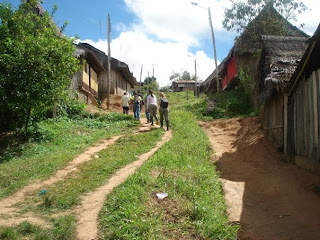
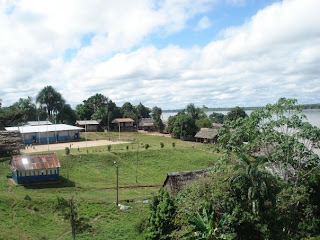

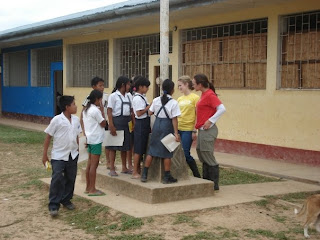
We walked up a winding dirt path to a simple wooden church with simple wooden benches and a simple wooden pulpit. Walking over to the "radio station," actually a microphone with loudspeakers outside, I met Segundo, a 16-year old resident and student of English, which was pretty decent, and Danielle's Spanish made up the difference. He showed us to the top of a hill with an awesome view of the village and river below, then to the school area where we met his English teacher. Similar to the last village, classrooms surrounded a concrete basketball court sized futbol field. The teacher's English was quite good, although the phrase "at this moment" was a tad overused.


He thanked us for coming and asked if we knew any songs in English to make learning more fun. A minute later I was writing the chorus of "I'll Stand" by Hillsong United and "Better is One Day" on his blackboard, tuning up an old nylon string guitar, and singing praises in English with the students. Osmar came in to help explain the meaning and common mispronunciations.

I ate a butter and jam sandwich hastily as we began Tu Has Cambiado, then Shackles. We taught several students some of the moves and did it again. Then Mark intro'd Doors and gave the gospel presentation. Jenn and I talked to a few adults, including a teacher I had met earlier. They were very receptive and appreciative and prayed with us after we walked through the tracts. We encouraged them to start going to church to learn more, to which they earnestly agreed. The English teacher then took the mic and thanked us, in English, and said "thank you and goodbye," which sounded like he was awkwardly telling us to leave. He followed it with "for this moment," and a chuckle, and gave the mic back to Mark.

I then joined Osmar, Tim Farmer, and Carlos on the futbol pitch to challenge some youngsters, who played a very tight and clean game and left us sweating profusely in the tropical sun. We walked down the hill to help with food distribution, as the governor called family heads by name to come and pick up the packages we prepared.
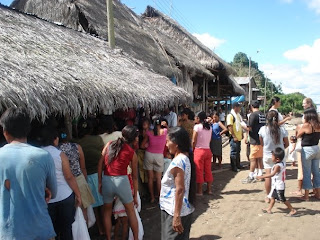

Tim Farmer learned from our bus driver, who was not a Christian but wanted to see a village and the jungle, how to say "this is a gift from God," to the recipients lined up. Meanwhile, Laura, Jenn, Danielle, Juanita, and Catherine led the children through a craft, making mariposas (butterflies) of wooden clothespins, gold pipe cleaners, and bright tissue paper. The kids loved it.
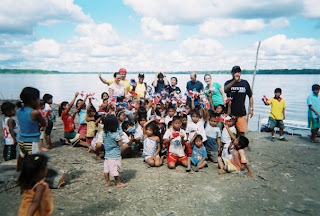

We then donned our rubber boots and ventured into the jungle to pray for people that live here. The boots were required to protect us from snakes and parasites that can get through simple fabric. A few steps into our trek, we saw a speckled hawk swoop down and grab a snake off of the path. Our guide said the snake was one of the most poisonous around. We crossed over a large muddy pond on unstable logs and a handrail that fell off, up and down a hill to thickening brush. We saw colorful pointed flowers and a butterfly with a wingspan as broad as your extended thumb to pinky, shimmering bright blue as it reflected beams of light. We crossed several more streams, as we hoped no one would fall, but eventually Catherine lost her footing and tumbled into the water below. She was an incredible sport and kept on with the group despite her soaked feet.

We travelled through fields of flaming brush piles and climbed over downed trees to what our guide said was a waterfall, but translation was imperfect, and our destination was a bend in a 20 ft. wide river. Mark, Tim Farmer, and I travelled a bit further in total silence to try to immerse ourselves in undisturbed wild. Something large scampered off the path, and we soaked up the variety of plant and animal life. Monkeys and birds called out from above, although I could not distinguish which was which. Some local boys found bright orange huayuru seeds and gave them to us. We hurried back and got on the boat to travel home.
Tuesday, June 3, Markets and Belen

After a couple hours of reflection, prayer, and repast, we worked on preparing for food distribution at another river village tomorrow. We went first to a supermarket, much like our own, but bulk rice and beans were unavailable. I just bought a drinkable yogurt, all the rage down south, flavored with lucuma (http://www.lucuma.com/lucumafruit.asp) which tasted like an oatmeal raisin cookie grown on a tree.

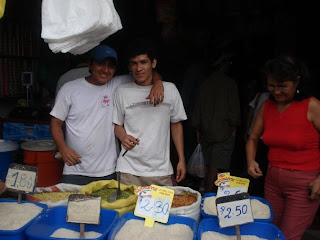
Next we went to a busy street market with storefronts boasting everything from rice and beans to cosmetics to motorcycles. We bought massive bags of both rice and beans, 100 bags of salt, and boxes of matches, as well as smaller plastic bags to divide up the goods for distribution. Back at base, we became a processing unit and within an hour we 100 bags each of rice and beans ready to go. We then took time to be quiet and prepare for a solid night of evangelism, broken only by lunch of stir fried carrots, broccoli, and chicken over rice with fried plantains on the side, my new favorite. The day was relatively cool, cold by their standards, enough to warrant long sleeves.


Around 2:30 we took motocars to Belen and met at the church to pray and meet up with some young members who would be our guides and translators. They warned us to cover our bags and stay together, and make sure that women stayed close to men. I passed a boy that said, "Hola gringo!" to which I smiled and said hola, completely unmoved by the derogatory term. We walked through a plaza to a side park area with a circular stage area about 20 feet in diameter, surrounded by a salon, some houses, and vendors of juices in clear plastic bags and cups of jello.


We played salsa music to grab attention before Mark and Cesar introduced Shackles and Doors. Mark also presented the gospel afterwards and many hands went up to accept Christ. One woman listening from a second floor window had her hand up, so I climbed two old appliances and jumped up to put a tract in her hand. Jenn and I called out what it said to her and she prayed tearfully with us to bring her to Christ. She then hobbled downstairs and we prayed for healing in her legs so she could go to church. We then spoke with and prayed for a much less receptive group in and by the salon, just before PR called out, "Let's go!"


We grabbed our stuff and walked to an open street area where we plunked down in front of a house with a woman in front of a grill, plating up food cooked in banana leaves. Houses were all on one-story stilts, often painted in bright pastels, and kids laughingly chased each other through the maze of people and motorbikes. Osmar grabbed attention by rattling off jokes and talking in a high pitched child's voice, then Mark introduced Tu Has, Schackles, and Doors. I noticed a group of high-school aged kids in soccer jerseys off to the left side. Some more came up, then walked off, and I prayed constantly for those still there, that they would have open hearts and that they would feel the tug of the Spirit. We wrapped up our presentation, and while Osmar shared his testimony on the mic, Jenn, Cesar, and I walked over to these guys. They had apparently become Christians at a very young age, but lost their passion, and wanted it back. We prayed with them to begin a new life with Christ. Then, "Let's go!"


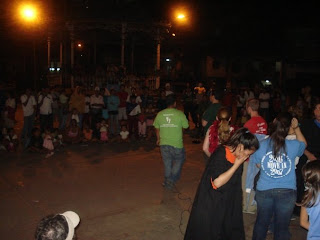
The third stop was the open plaza that we had walked through a couple times already. The sun was setting, but the plaza had lights (and roaming police officers). We did Shackles, then I introduced Doors, and after the drama I gave the message. I ran out of steam towards the end and asked Cesar to walk people through raising hands if they wanted to accept Christ and praying with them, but hands went up, and it was amazing to be used this way. Jenn and I prayed with a woman with an incessantly crying baby and a man who said that was already a Christian but did not know of any churches around. We connected him with one of the young members.


We walked with a feeling of victory back to the motocars and ate spaghetti and meat sauce back at the base in an exhausted state. Bedtime was immediate, since breakfast would be 5:30AM to get a jump on travelling to the next river village.

Monday, June 2, San Jorge

I woke to my rooster friend and sounds from the nearby kitchen for a 6AM breakfast. The bus left at 8AM to head to Nauta (http://en.wikipedia.org/wiki/Nauta), the only city connected to Iquitos by road (both are surrounded by rivers and isolated from other roadways). The drive took about 100 minutes, past small roadside houses of grass and wood, prisoners in orange jumpsuits clearing fields with machetes, women washing clothes in large metal buckets, and exotic trees scraping the skies with round tufts of leaves.


Nauta is a hillside town going down to the Maranon River, which flows north then east out of the Andes before it finds this little map dot. People sold food streetside and children greeted us with amazement and open hearts.


We got in a "real" motor boat, which was meant for fewer people than our group, resulting in a soaked left side of the boat. We cast out a few group members into a passing canoe of strangers that were willing to hold a few extra passengers while our first batch was dropped at San Jorge, our river village destination.


About 30 minutes later, we arrived at San Jorge, a beautiful little village of a few hundred people that live in open wood homes roofed with palm leaves. We explored the village and visited their small church, talking to residents and taking in the native flowers, birds, and trees. The people live simply and seem happy.


We gathered in a classroom at the school to eat sandwiches of butter and jelly or ham and cheese before bringing the schoolkids out for our presentation. We did Shackles twice, the second time with volunteers from the crowd helping us, then Doors. Mark spoke, translated by Cesar, about the gospel and asked for anyone that wanted to accept Christ to raise their hands. Jennifer Kim and I walked around to parents and gave out tracts and prayed for anything that they needed. I read the tract in Spanish to two ladies; my stumbling was humbling.


We gave out candy and small gifts to the children before a futbol game broke out. We played in loosely fitting rubber boots that the YWAM base said we would need, and the resulting blisters were intense. Once we finished, a new crowd had gathered, so we did Tu Has, Shackles, and Family, another drama more oriented towards children. Afterwards as we made our way through the crowd, Jenn and I spoke with a woman that asked for prayer. Her husband had left her for another woman, leaving their seven children (aged 1-19). She accepted our prayer for restoration and also accepted Christ as her Savior. We also spoke with a few men that stayed near the back. We read through tracts and prayed for them as well.

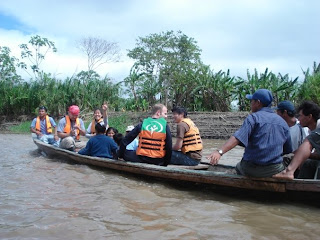
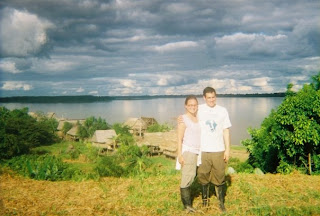
We were given the opportunity to buy local crafts, where I got a small turtle of wood and real shell that cost about a dollar. The first group went back on the speedboat, but Danielle and I took the open air canoe ride, which was such a better way to appreciate the glory of creation. Young kids paddled boats on their own alongside villages while I ate a yellow fruit that Carlos gave me. On the way back, Osmar (on the right side of the picture), a YWAM staffer and one of our local translators and guides, shared his story. He grew up in Iquitos to a broken family and frequently lived on his own on the streets. His friends got into drugs and alcohol at an early age (9 or 10) but he met some missionaries that he held onto and after gaining some language skills and working as a tour guide, he joined YWAM.


When we returned to Nauta, Cesar met a woman with a disabled child. Angie wore a bright yellow-green jumpsuit and was in a makeshift wheelchair with mountain bike tires and a plastic lawn chair seat bolted together. Nine years old now, she had fallen on her head five years earlier and has not walked since. She cries frequently for no apparent reason and has occasional seizures. We gathered and laid hands on her and prayed for several minutes. PR tried to help her up, but she was still unable to use her legs. We vowed to continue praying for healing and restoration and bid goodbye to her thankful mother.

Iquitos Exploration and Church Visit, Sunday, June 1

I slept well, waking only a few times to nearby crowing roosters. The breakfast bell rang at 8:15, welcoming us to scrambled eggs, white bread with butter and pineapple preserves, bananas, papaya juice, and tea. Bananas were small and tree ripened, tasting much sweeter and fuller than what we pick up in grocery stores. We met with Rene (http://www.ywamperu.com/en/lopez.htm) to get oriented, then practiced "Shackles" ( http://www.youtube.com/watch?v=xY848n09F_o)and "Tu has cambiado" our hip-hop dance and more tame body worship, respectively. Rene's son, Jaiel, a rambunctious and playful five-year old with endless energy, brightened the day with his laughter as we dribbled soccer balls around on the rooftop terrace.

We travelled in four motocars (http://www.youtube.com/watch?v=ldZvghfiKQY) to an Amazonian crafts market with beaded jewelry, dried piranhas, toy blow guns, and a little monkey running around.
Then we were off to the famous Yellow Rose of Texas, a restaurant with American and Peruvian food, owned and managed by a real Texan that spent time in Peru with the US military and never left. I chowed on alligator nuggets with yucca fries.

While our food settled, we travelled to a busy market area with countless grills serving up fish, fruit, chicken, and banana leaf wrapped goodies. We all got into a long canoe with a blue plastic tarp as a canopy and a long hand powered motor to get us around.


We moved from the wide Nanay river to the golden watered Momon river to an island zoo with monkeys rampant and a roaming anteater. The monkeys made friends with us quickly, climbing on our shoulders and heads. We saw and held anacondas, sloths, prehistoric turtles, and small gators. Juanita was the monkeys' favorite.


Back on shore, Carlos convinced us to eat grilled suri, a beetle grub found in decaying palm trees. I made the mistake of eating the head, a hard and crunchy part that you are supposed to discard, but it was otherwise rich and fatty with a slightly tougher skin, flavored with wood smoke. Not bad if you can keep your mind off what you're eating. We then had grilled nuts that tasted like roasted peanuts but were crunchier and more crisp. The abundance of the Amazon jungle is incredible.


Back at base, we showered and ate a supper of burgers with tomato slices and lettuce, trusting they were safe. We dressed in the best we had, old khakis and a blue oxford in my case, to head to Iglesia Belen, our partner church. We road motocars through less inhabited streets to a neighborhood with fewer streetlights, smaller houses, and plainly dressed people with years of hard life seen in the lines on their faces. Carrying our speakers and bags of props for dramas, we drew a few double-takes as we passed carts selling raw and cooked meats, peeled fruits, spices and sauces. I went into olfactory overload from piles of rotten produce and trash, fresh grated garlic and cumin, human and animal waste, wood smoke, and sweat. Two blocks down the road was the church, bright with yellow walls and filled with about 75 people young and old singing praises to God in the hot and stuffy air. I sat under what I realized later was the only working ceiling fan of about seven.

They finished two more songs, then introduced PR and our group. We did "Tu has," Tim Fermin gave his testimony, and we did "Doors," our primary drama gospel presentation. PR gave a sermon tying in Jeremiah 32:27 (I am the Lord, the God of all mankind. Is there anything too hard for me?), as written in Spanish on a banner over the pulpit, then called anyone that wanted to step up into church leadership to come forward, as well as anyone else that needed prayer. We layed hands on people and prayed passionately, and frequently they started weeping, sometimes shaking. This was an incredible reassurance of our usefulness and unity with the Spirit.

Tuesday, June 10, 2008

Saturday, May 31, Lima and Travel to Iquitos

After waking every 20 minutes, I touched down in Lima at 4:30 AM. It was relatively easy to get through immigration and baggage shenanigans, until I had to take the amplifier I was carrying for our street dramas through security. "What is that!?" I stammered, "speaker, amplifier, musica," to one stern guard, while another said, "it's ok, just push the button," which I am convinced he knew would light up red. Still, the x-ray and searches took only minutes and I was soon rechecking bags for Iquitos. We then met Mark and Cesar, two YWAM (http://www.ywam.org/) staffers that would lead our efforts. Cesar is a Lima native with a big smile, spiked hair, only a slight tint of Spanish in his English, and an air of friendly confidence. Mark is a wiry and energetic story-teller that looks a bit like a young Keith Richards (http://en.wikipedia.org/wiki/Oxymoron) with a faith that has been built on years of missions experience. I stepped away from the group to go the bano, which felt a bit like riding my bike away from my parents for the first time, as any conversation would likely end in "No hablo..." and a grin that says "you stupid gringo."

The air outside was rich and musty (a spot of rain had fallen, a portion of only a few inches that Lima receives annually), with smells of vegetation and light smoke. The early hour meant an empty parking area, where "Capitaine" had a small bus waiting and took us to Cesar's home to rest. We travelled fairly clean roads past some manufacturing plants, retail big boxes, and colorfully painted homes. Cesar lives in a clean and spacious pad with colorful walls and utilitarian furniture. We passed a bakery on the way to the second floor, which was heaven. Cesar and Mark bought 20 rolls, some ham and cheese, and a bottle of manzana yogurt. We ate in an awkward fatigue-induced stupor until Mark shared a story. I slept on an air mattress in a room cooled with a window open a crack.


Like the kid in the Disney commercial, I was too excited to sleep, and was up a couple hours before everyone else, with time to read, reflect, and prepare mentally and spiritually. Once Mark and Cesar were up and about, I accompanied them along with Tim Farmer and Danielle to a market area to explore a bit. Traffic is not nearly as crazy as India, but still worthy of serious attention where you're walking. Cesar told us to keep walking as they went to talk to the money changer, as rates can vary based on clientele, and a few obvious Americans don't help. We then passed three long lines at ATM's before finding a reasonable place to get some Peruvian soles. Apparently workers get checks every Friday and cash them Saturday morning, all at the same time. We found a fruit stand, filled with color and flavor.


We got back to an anxious Pastor Roger (PR), ready to head to his favorite Peruvian greasy spoon, Miguel's. Famous for sandwiches piled high with whatever you'd like and topped with a fried egg and cheese whether you like it or not, they were also reportedly safe for unaccustomed visitors. I got a chicken sandwith with two chorizo patties and the standard egg and cheese, delightful, washed down with some Inca Kola, a bright yellow Coke product with the flavor of sweet bubble gum (and interestingly, the Peruvian beverage market leader (http://en.wikipedia.org/wiki/Inca_Kola)).

From there, we were picked up by Capitaine and dropped at the airport again. Cesar took care of some logistical work at the airline desk and we then had to rush to pay airport taxes, a darling inefficiency, and run to our gate, only to wait for our plane to arrive. Meanwhile we met some American pharmacy students travelling to reserves in Iquitos to study natural medicines. I sat next to Azzam, a guy from this group, on the flight, which ended majestically over forests with monkeys swinging from trees and mists rising at the magic hour when the sun makes everything seem surreal. We got off and jumped on a small bus and followed Rene and Keith on motorbikes to the YWAM base to end our 30 hours of travelling.

Despite our fatigue and readiness to sleep, our watches read 8:30, so we travelled by motocar to Plaza de Armas, where we were met by street vendors with candy and balloons, a bright glowing fountain, street performers, and a bright Catholic church. We bought postcards at a Christian-owned small shop, saw "human statues", and some kids with fake instruments made of wood that were jamming to their own tunes.


Friday, May 30, Miami

La Carreta, the Cuban restaurant in the Miami airport, has mediocre food, but phenomenally flavorful habanero hot sauce. It was still tingling warm in my gut the realization hit, "I'm not sure what I'm doing here." I'm confident of God and His presence, but I'm curious what I can do in Peru without Spanish. I am also fearful of how spiritual warfare could materialize on this trip. My eyes are getting heavy and I hope I can sleep refreshingly on the plane, which would be a first. I will need to rely on God for everything on this trip, yet I feel remarkably comfortable about that.