Wednesday, May 26, 2010

New blog site

This feels wrong to post on blogger, but I am starting a new blog site on wordpress. Please check it out here: http://www.jolloway.wordpress.com/. The site explains the reasons for the shift and my ambitions for writing in the near term future.


Goodbye.


Monday, April 26, 2010

Prague

Northern Germany rivals Kansas in flatness, making it a perfect site for thousands of windmills, which blink red in the night like a scene from the X-Files. Similarly odd, but also supporting the German economy, was the string of RV’s with cabin lights on signifying they were “open.” My friend Chad invited me and two Chinese colleagues to join him for a weekend in Prague, and I welcomed the liberating excursion. I let Chad explain the RV’s to our two colleagues.

A brief tangent: incongruous systems of measurement and voltage make some sense to me because of the cost of standardization, but why can’t we all agree on names for places? Is Praha too hard to say? Why does each language create a name for various countries?

Prague has an interesting mix of disturbing history, architectural class, and reserved vivacity. Communist and Nazi occupation left mental and physical scars- in Wenceslas’ Square workers replaced the marble chipped by Communist bullets with off-color material in remembrance, and Hitler’s failed plan for a museum of an extinct race left a remarkable treasury of artifacts to help us grasp the atrocities of recent history.


Prague has a reputation for being a musical city (they have a giant metronome keeping rhythm for the city for Pete’s sake), but I was a bit too eager, and ended up getting duped by an overly commercial gig. Real classical musicians don’t play just the 3-5 minute popular themes of pieces (which pissed me off enough to write “pissed off” here- sorry Mom), and it took focused effort to relax and forget the fact that I had been had so I could actually enjoy it. The musicians weren’t bad, it just wasn’t heartfelt. Sort of…plastic.


But back to the metronome- I looked up the story behind it after I got home, and the explanation of the metronome is weak, but before the ‘nome, a 50 meter tall 17,000 ton marble statue of Josef Stalin stood there. The statue took 7 years to build, yet only 7 years after its unveiling, on the orders of Krushchev, the new Soviet head who denounced Stalin, it was blown up with 800 kg of explosives (what else could you possibly do with a 17,000 ton statue of Stalin? (source: http://www.radio.cz/en/article/66095)).

February-March in Denmark

February in Denmark

It took too long to make this post because February was one of the hardest months I’ve had in a while. The ache of being away from my wife became more acute. Delays in my project at work stole my enthusiasm. The cold grey sat brooding, sapping my optimism. My joy in the thriving church I found faded as I saw the blemishes and it became simply a place to connect with friends (extremely important, but not everything). Worst of all, it was too windy to cast a fly. It’s tough to see the silver lining from inside the cloud.

What did I learn? Much: to drop the custom of assuming high mutual respect, to not think too highly of myself, to speak up at the right time (not before, not after), and most important- to dig deep for the real well of joy rather than letting circumstances drag down my mood and influence my behavior. The realization that my situation was impacting my attitude challenged my faith in Biblical truths and myself. I have long believed that following Christ is the best way to live and is filled with a joy that cannot be stolen. To live this out is tougher than I previously understood, but now I know it’s true. As my prayer become more real and my choices of how to live each day took hold, my perspective picked up and I found that as I renewed my belief in God, God also believed in me and gave me new opportunities. Like the adage shared among fraternity pledges: “that was the best experience I never want to have again.”

Thanksgiving at Easter

A few years ago one of my best mentors invited me to understand strategy in a new way. He asked me why I thought he did certain things, gave me insight before and after he held meetings, and uncovered elements of our strategic direction that he intentionally did not share with most people. This exposed two simple revelations: there is much more strategy all around than we realize and we can be more strategic in daily activities to achieve more. I feel like God exposed different perspectives of this idea this week. Since January, adapting to new things and separation from many basic joys stretched me more than I anticipated, and many things I was looking forward to didn’t turn out as I had hoped. The week I just spent at home was a bright oasis from the cold grey. Prayers for humility and spiritual preparation for living a missional life were answered like a band-aid pulled off too slowly.

My losses have been temporary and even as I sat jetlagged in Copenhagen’s Kalstrup airport listening to Aaron Copland with black coffee and enduring a seven-hour layover, I realized I brought a bit of sunshine back with me. I left 80 degree weather to find it too cold to sit outside here even wrapped in my coat, though after my little retreat I have renewed confidence and vision. I understand why God let me feel lonely and weak as I learned to lean on Him more, and I can now feel gratitude for the experience.

Friday, February 19, 2010

London- business view

In travelling to London, we got to experience two blue ocean business models: Ryanair (http://www.ryanair.com/en) and Pret a Manger (http://www.pret.com/).
If you haven't been, the US Pret site calls the shop "a cross between a good restaurant, an Italian coffee bar, and a bullet train," and Ryanair is the airline that last year asked passengers if they would be willing to give up their seats for cheaper fares (http://www.ryanair.com/en/news/free-flight-would-you-stand).

In the phenome, "Blue Ocean Strategy," (BOS) W. Chan Kim and Renee Mauborgne argue that Pret a Manger correctly identified that existing market options did not meet market demand for a fast, healthy, and reasonably priced option (105-106). While the British Pret site admission that they were started by college friends with "woefully little experience in the world of business" shows that you don't need to read BOS to come up with BOS business plans, Pret serves as a fine example to apply elsewhere. Below I applied the BOS strategy canvas to Pret:

Pret clearly goes against the grain of both fast food options and nice restaurants, converting far and near non-customers. When we went to Pret, I was impressed that everything I saw looked appetizing, with sandwiches that took your Panera ingredients a step more creative, seasonal soups and espresso drinks. Prices were about right to tempt daily and it's the kind of place you just feel cool going to.

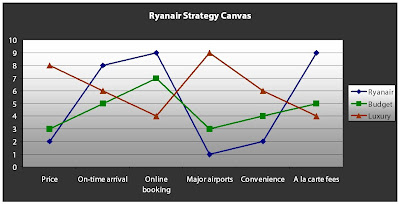
Ryanair is a bit more controversial. In a WSJ article/interview published on 12/10/10 entitled "O'Leary Pilots Ryanair Into Lead With 'Mad' Ideas for Cost Cuts," it is clear that Ryanair's business model is unique not only in messing with the strategy canvas to deliver a unique mix of benefits to passengers, but also that the company is trying to change consumer behavior. Charging for checked bags means that fewer people will check bags and Ryanair needs fewer people to load and unload those bags on planes. The infamous, and since revoked, proposal of charging to use restrooms will push more people to go before boarding, which will reduce the number of restrooms needed on a plane, freeing up space for more paying passengers. Another WSJ article dated 2/01/20 called "Ryanair Aims to Bank on Rivals' Pains," explains that while it's a tough time for all, their ancillary revenue scheme is paying off financially. Here's a similar shot at classifying how Ryanair is different:


So what's it actually like? To manage the baggage size and weight limits I had to leave my standard US-size carry-on (too wide), managed to fit clothes for 4 days in my laptop case, and took the advice of fellow bloggers to simply cram a bunch of crap in my pockets. I was concerned when the plane we were to board arrived only 30 minutes or so before our scheduled departure, but they pulled it off (things like removing seatback pockets have trimmed cleanup time). The flight was on time and the cheapest fare I've ever paid (something silly like $5). It was no big deal to ignore the repetitive pestering to buy drinks, snacks, magazines, and smokeless cigarettes. However, I underestimated how far away the airports were. I spent a lot more money and time getting to Billund from Sonderborg, and to our London hotel from Stansted, than the flight itself. My verdict: unless I can fly out of and into a convenient airport, it's not worth it. Put a value on convenience and factor it in. For me, it was novel to fly once, but I got a bad taste in my mouth, and I didn't even try the smokeless cigarettes.

Sunday, February 14, 2010

London- slideshow

Trafalgar Square from the National Gallery Steps:


Danielle, London Eye, Thames, and nice photogenic sky:


I was severely disappointed when I saw this, because the Rosetta Stone website says they offer 31 languages, but I only saw three on this thing in the British Museum:


Lady making funny face to the left of Danielle, oh yeah and Big Ben:


Steamy paella on cold day in Portobello Road Market:


We saw this statue, Danielle asked who it was, I assumed some British luminary and replied sarcastically, "George Washington," but we got closer and it actually was! Right outside the National Gallery. Brilliant!

Me outside Westminster with my handwarmer:

Monday, February 1, 2010

January in Denmark

That's the scariest title I could think of. I decided to write monthly recaps of life in Denmark as I go, and have periodic special reports on a few preselected and TBD topics. So here we go:

The cheapest flight over passed through Helsinki, where as we landed I saw the imagery the Polar Express was based on, and once inside the airport learned what an extremely thorough security pat down feels like (a little gross). Danielle and I broke a sweat running through the airport to catch our connecting flight that should have already left, though in the first and only exemplary customer service I have found here, they held the flight to Copenhagen so the dozen or so of us could board.

We had just one afternoon in Copenhagen, but we were jetlagged and freezing so we walked around a bit, drank too much coffee just to stay warm, then had dinner so early that our lunch-shift waitress left halfway through our meal and we had to wait 15 minutes because we weren't technically allowed to put in entree orders yet. The food was good, but our bodies didn't really know what meal it was supposed to be, and then we went to bed at 7pm. We'll go back to do it right some day.

To continue two themes, we had a quick bite as early as the hotel would allow, then ran to the train station to get to the airport in time to run to a shuttle and then run to catch our flight. We made it and around 8am had landed in Sonderborg, my new home. My apartment is small but sufficient, though of all things the bedding made me wonder if I could survive here. The mattress is ok, but the pillow is just a loose bag of cottonballs, and the sheets are faded pastel patterns that look like they were stolen from a hospital. Anyway, we quickly checked off the requirements (ID card, bus pass, initial groceries) and took off for London, which was frigid but fascinating and will be a post in itself.

The goodbye was very hard for both of us, softened only a bit because we had already planned the next three times we would meet up and had sort of been saying goodbye for a few days already.

Here are just a few highlights and lowlights of life here so far:

* I like coffee a lot, and the coffee machine at work is an automatic espresso machine. Coffee is espresso and water (cafe americano). My favorite "dessert" after lunch is two shots of espresso and one small hot chocolate.

* Church- I found a good Bible believing church that has enough internationals to have a live translator in the back which feeds into sets of headphones at several seats. I've made a bunch of friends which is helping to overcome what has been a very lonely time for others in my shoes.

* Running has been a bit tough due to the cold and snow, but my longest run took me through a quiet stretch of forest with waves breaking on the rocky coast below, which was glorious.

* I work with a guy that helped rebuild a viking ship and lives in a 300 year old house with a thatched roof. He's helping me plan some cultural outings.

* Gripe #1- customer service that starts with "didn't you see the ___", as in "didn't you see the 'F' next to those bus times?" (which obviously meant only on Friday, duh) or "didn't you see the option to report the problem to the webmaster" (and no I won't help you with your plane ticket) or "didn't you see the information on cancelled buses under...", (and no we are not interested in reimbursing you for the taxi you had to take instead).

* Gripe #2- exactly 2.7% of Sonderborg residents shovel the snow on the sidewalks in front of their homes and businesses, and exactly 96.8% of drivers look at me like I'm picking my nose (while I'm not) and/or try to run me over when I run on the very edge of the road because only 2.7% of the sidewalks are shoveled.


Sunday, November 29, 2009

Cafe Yungas


Since wrapping up the Perspectives course, I have had the chance to visit Bolivia to shadow some missionary friends and learned about a great initiative called Cafe Yungas. Please check out www.cafeyungas.blogspot.comm for more. In short, our friends in Bolivia are purchasing coffee from local growers to help them earn a fair price and grow coffee rather than coca (the primary raw ingredient in cocaine), and I am helping to sell it in the US, with 100% of net profits going back to leadership development in Bolivia. Email me (jonathan.w.holloway@gmail.com) if you want to support this cause by buying a few bags of coffee as Christmas gifts.

Saturday, June 20, 2009

Perspectives- Tat Stewart

Tat Stewart was raised the son of missionary parents in Iran and speaks perfect Farsi. He was pushed out of the country in the Iranian Revolution and came to the US to study. He has since planted churches in the Muslim world and now broadcasts sermons from Colorado to Iran. Tat addressed the topic of Pioneer Church Planting, which focuses on two issues: encouraging a church movement to express the cultural identity of a single people group and handling the radically different cultural complexions of churches that grow in frontier mission situations. The following points combine Tat's practical advice and experience with takeaways from the week's readings:
  • Though we naturally color our message with our culture and experience, the gospel can cause cultural extraction, and this is not always the missionary's fault. Look at how Christ was extracted from His home.
  • Christianity was not brought to Iran from westerners, but by Persians. In fact, Iranian Christians took the gospel to China.
  • In the Middle East, all dreams have significance. Many people that Tat prayed for had dreams that led them to Christ.
  • Muslims often don't believe our words because they have been lied to many times. Debates rarely produce fruit. They generally judge truth by experience.
  • Tat built Bible studies in new believers homes in Iran, making sure that whole families were there, and asked tough questions and pointed them to scripture.
  • America lives in the future, always thinking ahead, but Iran lives in the present, focusing on what is happening with people. This can make ministry and team building in Iran very frustrating to Westerners.
  • Muslim literally means "submitter to God," so some missionaries take that name and allow Muslim converts to retain almost all cultural habits and religious forms. This walks the line of enabling syncretism and contextualizing, and is a controversial means of sharing the gospel.
  • By being too careful to ensure true beliefs and right practices, church planters can create a bubble viewed as foreign to a local people. By being too careless, church planters can allow surface level changes that do not address core beliefs.
  • John Travis (a pseudonym for a church planter in the Muslim world) presents seven concepts that new believers need to hold to avoid syncretism: Jesus alone is savior, follow Christ in community with other believers, study the Bible, renounce and be delivered from occultism, religious customs are not performed to earn merit, religious beliefs are examined in light of scripture, and show evidence of new birth and growth in grace.
  • In cross-cultural church planting there will be syncretism, extraction, and misunderstood contextualization, but we need to go anyway and recognize that God will use us. We can also be sure that if we stand for the Cross there will be suffering.

Tat brought two Iranian friends that became Christians through his ministry and they expanded and confirmed Tat's comments about Muslim and Iranian culture. Tat also shared an encouraging story of how God works outside of our efforts. A man said out loud to Jesus, "I don't believe in you, but if you are God, prove it." He had a dream that night where he was suspended in the air right in front of Jesus crucified and could see his sweat and blood and feel his breath on his face as Christ said, "I did this for you. Believe me." Not all doubting prayers bear the same fruit, but God cares deeply about all people and does remarkable things to bring them home.

Saturday, June 13, 2009

Perspectives- Michele Rickett

Michele Rickett founded Sisters in Service (http://www.sistersinservice.org/) to lift women and children out of poverty in the least-reached places in the world. They do this by building relationships with Christian leaders and empowering them to change their communities through education, spiritual development, and creation of economic opportunities. Michele addressed the topic of Christian Community Development, providing a glimpse of the needs throughout the world and some of the efforts to help. It's impossible to capture the emotion and stories she shared in writing, but here are a few bullet points of the information she passed on:
  • In the US we see relative poverty (people without homes struggle to get by), but in the developing world we see absolute poverty (people are unable to meet basic needs).
  • The world is filled with conflict, poverty, oppression, thirst, hunger, disease, and illiteracy. How should we respond? By entering into the suffering and doing what we can to help. We can also remember that one day, when the gospel is provided to all, this will all end.
  • Hope integrates us and motivates us. Look at Jesus' compassion, commission, and example for hope.
  • God's kingdom of righteousness and goodness will come. He will build His church, and He wants us to be a part of it.
  • There are four main approaches to human need: economic development (macroeconomically focused, criticized as ineffective), political liberation (good, but not the hope we need), relief (important, but not long-term), and transformational development (long-term focus on empowering people).
  • God is evident in transformational development as people and initiatives are empowered, divine intervention is apparent, and transformational genuine love is shared.
  • Poverty is often caused by broken relationships, misused power, and fear.
  • Four things need to be restored to empower people to escape poverty: hope for a better life, dignity to break oppression, authority to step out of a situation, and identity as a child of God.
  • Six integral mission factors were discussed: becoming agents of change, gaining a vision of change (imagining what God can do), assessing available resources, using proclamation and deeds (tell why you do what you do), prayer (different weapons are needed for this battle), and time (it takes 5 minutes to save a life and may take 5 years to transform it).

As a transformational development practitioner, Michele had many first-hand examples of how God is working miracles to break through traps of poverty. To learn more, she recommended Tim Chester's book, "Justice, Mercy, and Humility." The most important point of this lesson was that we need to think holistically in our service efforts. Poverty can take many forms, and we have tremendous resources to share. The choice of whether to share is ours.

Thursday, June 11, 2009

Perspectives- Scott Buresh

Dr. Scott Buresh, a professor of anthropology at Towson University, spent 18 months in Aceh in Muslim boarding schools, living as the local culture does. He taught on the topic of "Building Bridges of Love," which addressed cultural issues, tying lessons from Jewish tradition in the Bible into modern day evangelization models. First, Scott led us in a meditative reading, Lectio Divina, where he first read a passage, then read it again and asked us to listen for key words or phrases that God may be pointing us towards, then again and asked us to seek an application in it, then again while simply letting the words wash over us. Here are some key points that I took away from Scott's teaching:
  • The #1 value in the US in independence, though we should plan to live as communities of disciples, since individually we are all very poor representations of Christ.
  • Jesus was able to do what He did because He relied on His Father, not because He was God.
  • If we would teach what Jesus taught in the way Jesus taught, we would experience the same response. Jesus was perfect, but He was still rejected.
  • Jesus was fully immersed in Jewish culture, and was fully dependent on His culture to learn language, Aramaic and Hebrew in this case. He was a real carpenter in a small town. He went from the throne of glory to this, for the sake of people. How much less do we need to give up to reach others?
  • Jesus taught, "Repent (reconsider what is reality) for the Kingdom of God (God's presence, His rule, His power) has come near (immediately available)."
  • Jesus taught in daily interactions while travelling, in the temple, out in the open, and He taught through stories, making ideas relevant to an audience.
  • It is important to serve humbly and with integrity when entering a different culture. Taking a single true identity as a servant that genuinely cares about the community will go farther than misrepresentations that seem to bring one closer to a culture. It is also imperative to keep this identity at home and abroad.

Scott closed with stories of those that have taught what Jesus taught in the way Jesus taught. The early church saw martyrs dying with joy and peace because they had tapped into the Kingdom. The Celts missed persecutions suffered elsewhere and left the Ireland they knew to teach and transform the uncivilized countryside. Hudson Taylor recognized cultural differences in China and took theirs on, serving as a teacher. Frank Laubach took a fresh approach of teaching people in the South Pacific how to read, by requiring that each student teach someone else what they just learned before he would teach them the next lesson. Each of these required some sacrifice and full devotion to God, but each transformed the world for others and for God's glory. It's worth it.

Saturday, June 6, 2009

Perspectives- David Shenk

2/3 of the world are oral learners. Yet many missions efforts focus on disseminating information rather than relating stories that can be heard, learned, and repeated. A result of such cross-cultural miscommunication is found in a phrase that Hong Kong street vendors use to mean "you're crazy, knock it off," which is literally translated as "stop talking Jesus to me." This week, David Shenk addressed the topic of "How Shall They Hear," covering cultural understanding and communications issues. Shenk was born in Tanzania of missionary parents and has spent much of his life understanding Muslim culture and writing books on bridging cultural gaps. Here are a few key points he addressed:
  • Lloyd Kwast put forth that there are four layers of culture: Behavior (what is the normal way of doing things), Values (what is good or best), Beliefs (what is true), and Worldview (what is the meaning of life and death and what is forgiveness for my shortcomings).
  • Every culture has a worldview that influences other layers, though technological improvements (e.g. cars into Fatalist culture) and cultural imports (e.g. Hollywood into Confucianism) create dissonance. If you seek to change behavior without addressing worldview, you get meaningless surface level changes.
  • Cultural constructs are often divinized; people create gods that reflect themselves, shortcomings and all. This means that repentance is unnecessary. When a worldview changes to reflect the truth of the gospel, repentance is instantly required.
  • Don't assume that people want what you perceive as their greatest need; ask them and it may be that God is their greatest need.
  • The gospel affirms yet transforms culture, by empowering people to confront evil.
  • There is a metanarrative (great story) in every culture that explains the worldview. For instance, the Darwinist metanarrative explains that we come from a primordial goo out of which the strongest have survived and humans are the apex of life. This feeds violent repression as people strive to survive by being stronger than others.
  • The first priority in bringing Christ to a people group is translating the gospel into a meaninful communication that reflects the culture. This should be written, but there should also be a metanarrative communicated in a way that people relate to.

David Shenk closed by digging into how the Islamic worldview overlaps with the Christian worldview and discussing his interactions with Muslims (he co-authored a book with a Sheikh discussing beliefs in a mutually respectful manner). It is important to remember that while it is imperative to contextualize the message, Christian witnesses do not convict people to believe. Even Jesus did not convict people to believe. It is our job to spread the word, and the Holy Spirit will convict people of the truth.

Sunday, May 31, 2009

Perspectives- Tad de Bordenave

Tad de Bordenave, the Director of Anglican Frontier Missions, was small as a kid and nicknamed "Tadpole," which stuck. He addressed the Perspectives topic of "The Task Remaining," which he expanded to "The Scandal of the Task Remaining," which he thought was more appropriate due to the clear potential to reach all people groups with the gospel but lack of mobilization. Here are a few thoughts that Tad shared on why the task remains, how to recover the vision, and the tools that are available:
  • Many Christians never go into missions because they ask the wrong questions. The point is "where is the greatest need," not "where am I called." How could you be called to a people group you have never heard of?
  • Some don't sense the need because there are many missions efforts already. But over 70% of evangelical missionaries work within groups that are already predominantly Christian.
  • There are many reasons to delay, from more pressing needs that take precedence at home (once we fix the floor over there we'll go), to the heresies at home (we need to get our house in order first), to the messiness of missions (we just want to get it right, so we'll keep training). These will never be resolved; at some point you just need to invest.
  • We can regain the vision by recognizing the call of the church, which is to be God's witnesses to the ends of the earth. The Bible is clear on this. God's glory is being usurped by idols.
  • Tad brought up justification without distinction, the idea that we as Americans have done nothing to deserve grace, yet we have all the toys (money and stuff). Why do 22 million people in Yemen live without Christ? Because we would rather enjoy our toys than accept God's call to serve.
To start to get involved, Tad recommended living virtually in a local foreign community, learning all you can about a people group, meeting them, hanging out with them, and praying for them. A two-year commitment will change you. Tad closed by narrating amazing stories of breakthrough in the Aceh of Indonesia, the Qashqa'i of Iran, and the Marwari of India, each unique demonstrations of how Christ can overcome what seem to to be insurmountable barriers.

Saturday, May 16, 2009

Perspectives- Karen Michener

Karen Michener of the US Center for World Mission taught us about Eras of Mission History and Pioneers of the World Christian Movement, an essential history to understand the progress that has been made and the task remaining. She pointed out the most important point of Perspectives, a quote by an Indian evangelist: "Do not bring us the gospel as a potted plant. Bring us the seed of the gospel and plant it in our soil." Several key concepts were explored:
  • Modality (local church, inward focused, stability) vs. Sodality (missions focus, risk tolerant to achieve big goals) in missions efforts. Both are necessary for healthy churches.
  • Through the centuries, people groups have heard the gospel by coming to Christ-followers and by apostles going to the unreached, both voluntarily and involuntarily, all of which God has used for His glory.
  • The 1st Era of Missions History was led by William Carey, with Europe as the primary sending region, and was focused on the coastlands with a church and kingdom mission.
  • The 2nd Era of Missions History was led by Hudson Taylor, with America as the primary sending region, focused on inland areas with a church mission.
  • The 3rd Era of Missions History was led by Cameron Townsend and Donald McGavran, with the non-west as the primary sending region and a focus on unreached people groups and a recover of the kingdom mission.
  • The E-Scale rates evangelization of non-Christians from similar through very different cultures. E1 (same culture) is the most powerful because it spreads quickly and easily, though E2 and E3 are the highest priority strategic efforts because they can spark new movements.
  • Missions efforts should go through the following phases: Pioneer, Parent, Partner, and Participant. As local churches gain momentum, the expat church planters should empower local leaders and step back.

Karen reminded us not to be people blind, a term for the tendency to lump local people groups rather than acknowledging the differences. She recommended "From Jerusalem to Irian Jaya" by Tucker to learn more about missions history and http://www.partnersfortransformation.net/ to get involved.

Sunday, April 12, 2009

Perspectives- Fran Patt

We opened this session hearing from Ravi Zacharias on Adonirum Judson, which is worth a listen (http://www.youtube.com/watch?v=k0RRU67DKwc). Fran Patt of the US Center for World Mission is also a professor of history at Penn State. He broadened our historical understanding speaking on "The Expansion of the World Christian Movement." To build on this base, he recommended Fox's Book of Martyrs to dive deeper into what passion for Christ looks like. Here are some key points:
  • Pax Romana, Roman Peace, was the atmosphere in the most powerful empire in the world, a diverse, pluralistic, assimilating world, with a dominant Latin presence. Romans were excellent engineers, builders, and organizers, and total control freaks. Into this world, Paul and Barnabus planted house churches.
  • The first century church saw tremendous growth through the Roman empire and was assimilated into the culture, to the point that Christianity became associated with Rome. The gospel became "Learn Latin, become Roman, then be baptized and saved." Constantine organized the church, efficiently chopping neighborhoods into diocese that had to go to specific churches.
  • In the 3rd and 4th centuries the west was overrun by Germannic tribes the east became the Byzantine Empire, and the Roman church became organized in a power structure to match the government. There was no accountability because lives were driven by power, not humility.
  • Patrick was an apostle to the Celts, establishing a totally different approach to Christian life, focused on contextual mission to other cultures,and strong lay leadership, as opposed to the Roman ethno-centric order with a strong clergy-laity dichotomy. Patrick baptized over 100,000 Irish.
  • The Roman model of evangelism was contrasted with the Celtic model, both of which are important and appropriate for different circumstances. Roman: present message, invite decision, welcome them into your church and culture. Celtic: bring people into fellowship in your community, engage in conversation of prayer and worship, in time they discover they believe what you do and you invite them to commit to it.
  • Logic works when someone agrees with you (i.e. intraculturally) and is cheaper and easier than the Celtic model, though not as relevant in cross-cultural ministry.
  • After no Christian missionaries went to Arabia for six centuries, Muhammad proclaimed that God was speaking through him. The task of his followers is to spread submission to God to all the ends of the earth. Moslems originally thought they were converting to another kind or denomination of Christianity.
  • Then for over 250 years, "Christians" killed Moslems in the name of Jesus, and the cross came to represent this atrocity.
  • Ramon Llull tried another approach, and went to North Africa in his mid-60's, preached and was deported (the aged were revered, so they didn't kill him). He spread the word through Europe to teach Arabic to reach the Middle East and North Africa, then returned to Algeria, only to be stoned. 650 years later in Algeria, a man saw a dream of a man being stoned in a village that looked like his. After it recurred for several nights, he told his wife and neighbors, and eventually found out that all 700 in the village had the same dream. Then Jesus appeared to them in dreams and many came to know Him and trust Him.

Fran left us with two questions: are we here to dominate the world or live the life of Christ, oftentimes suffering the same way to demonstrate His love? Is victory or suffering our motif? This session also made me think a lot about Catholicism in the cultural context, theology aside. Catholics carry on the traditions and cultural style of Roman worshipers. The fact that the Catholic style of worship is still comfortable for many should not be criticized as wrong, nor should any traditions and rituals that honor God be shunned. Whatever brings people closer to God in a righteous way is good. However, it is similarly wrong to push traditions that are not relevant to upcoming generations on them as the only way to worship. By insisting that Catholic traditions, or American Protestant styles for that matter, are the correct way to honor God, we copy the Pharisees, those most criticized by Jesus. We should approach our American neighbors with the same cultural awareness, bringing the gospel in the most accessible way.

Saturday, February 21, 2009

Perspectives- Bruce Koch

This session started with a screening of "Ee-taow" a pretty remarkable documentary of missions to Papua New Guinea. (http://www.youtube.com/watch?v=LSBLLuzqfBQ&feature=related (part 1) http://www.youtube.com/watch?v=SyOBPvZSjtE&feature=related (part 2)) Part 2 at 3:45 is what this is all about.

Bruce Koch is a co-editor of the Perspectives course and part of the staff. He took us through "Unleashing the Gospel," a lesson on how the gospel spreads across cultures and people groups, with a focus on Acts 15:19- that the early church deliberately decided that people are free to follow Christ in their own cultures.
  • The Old Covenant required sacrifices every year, which still didn't relieve the conscience. The New Covenant is once for all, enabling us to freely come to God. The Old Covenant dealt with external issues (cleansing, rituals, behaviors), which is why it was hard to accept that outsiders were coming in to enjoy what they had come to know for thousands of years.
  • The term "Christian" was first applied to Gentile believers as a derogatory term.
  • Evangelicals should not try to "convert people" as Jews tried to convert people to their religion and culture, but see people come to know Christ and the freedom He brings.
  • In Peter's encounter with Cornelius, the Roman soldier (Acts 10), Peter is the one that is converted. The Gentiles come to Christ and receive the Holy Spirit, which converts Peter's mindset to that of a multi-cultural missionary rather than an ethnocentric Messianic Jew.
  • Christianity is not a religion because there are no rules. It is wrong for some to eat meat sacrificed to idols and ok for others. There are guidelines not to indulge in sin and to have to conform to some leadership, but the whole body is diverse in the way it follows Christ. It is God that purifies men's hearts, not our teaching or conformity to the practice of our religion.
  • We need to be slow to judge- "do not call anything impure or unclean that I have made clean." God can change traditional cultural practices to bring Him glory.
  • People do not need to become "Christians" as we use the term, which has negative connotations of loose morals and greed to many Middle-Easterners.
  • It is the believer's responsibility to become like another culture to get past communication barriers, and allow an audience to remain like their cultural norms in their belief and obedience to Christ. Following Christ is not about how you dress, what songs you sing, and how you worship.
This session closed with a cross-cultural worship experience where we learned some Arabic words and prayed as Middle-Eastern Christians might. It solidified that Western worship styles are no better than those of other cultures, but that all worship in Spirit and in Truth brings God glory.

Perspectives- Jim Rhodes

Jim Rhodes is a 30-year Campus Crusades missionary that has planted ministries in the USSR, Japan, Africa, and most recently the Middle East. His introduction to Middle Eastern ministry came when his friend convinced him to join him on a trip to Cairo in the mid-1990's, dropped him in the middle of a crowded plaza and took a taxi to take care of some things. The crowd turned and shouted "American!" and though he thought this would be the end, he really just had to work his way through the crowd buying trinkets and sharing personal space. He said that though it was a new strange place, he felt at home like never before, and his ministry has flourished there. The topic was "Mandate for the Nations," which dug into the Great Commission and related commands. We walked through the history of Judaism and how the These points struck me:
  • Every kingdom has a king, so Christianity is not a democracy.
  • Al Qaeda is the modern-day Ninevah, where Jonah tried not to go. What is our response for today's "evil empires?" Are we praying for those people?
  • God's heart is to bless and save, ours is to curse and destroy.
  • The Israelites were under 700 years of military rule, 400 of which God was quiet, and into this world Jesus came.
  • To protect their core tenets, Jews were ethnocentric (our culture is best), legalistic (built 6,000 hedge-laws around the 613 laws of Moses to protect against serious infractions), and had a fortress mentality (protect blessing by keeping others out).
  • Accountability, a popular Christian discipline, can protect against sins but does not change the heart.
  • Street interviews have revealed that Christians are perceived to be against lots of things, which is exactly like the Pharisees of Jesus' time. Christ was against the Pharisees most of all.
  • Matthew (a tax collector that took Jews' money to pay Rome, i.e. a traitor) is used to proclaim the Messiah to the Jews. He explains that Jesus has a clear blood line to Abraham and David, but also has blood of other nations mixed in. Therefore, He is the King of the Nations.
  • Jews of His time were not as mad about His claim to be the Messiah, but that Gentiles were in God's favor. The Samaritan woman, a line descended from mixed-blood Jews, was the first that Jesus told that He was the Messiah.
  • In Mark 4, Jesus goes across a stormy lake where the disciples nearly drown to a really bad town where the disciples are attacked by a demon-possessed lunatic. Jesus heals the guy, then they turn around and go back. This one guy was important enough to Jesus for the whole trip.
  • If people really know who Jesus is, they will want to follow Him. But so few know Him.

Jim closed with two points. First, if you are going to walk with Jesus, you have to go with Him, to seek and save what is lost. We were created to have a place in the Kingdom, we just have to find out what it is. Second, it is impossible to say that the Spirit indwells you and not be involved in evangelization. We are blessed to bless others. The question is how we will follow Him.

Sunday, February 15, 2009

Perspectives- Scott Simmons

This week we heard from Scott Simmons, Assistant Pastor at Chapelgate Presbyterian Church in Marriottsville (http://www.chapelgate.org/), on "Your Kingdom Come," which bridged the Old and New Testaments. This quote kicked off the teaching:

"North American evangelicals tend to read the Bible through an individualistic and spiritualized lens. Built into that lens is the idea that future-individual-salvation of the soul is the center of Christianity. The lens causes many evangelicals to interpret all else in relation to this center... As long as this lens is in place, much of the Biblical holistic gospel will either be spiritualized, rejected or considered an appendix to the gospel."

  • The gospel is both individual and global. Both the individual blessings of justification by faith, forgiveness of sins, and eternal life and the global blessings of reconciliation with God, reclaim of creation, and social justice are immensely important.
  • Jesus proclaimed the radical idea that salvation has nothing to do with race and nationality but just faith, which drove His contemporaries nuts.
  • The Old Testament scripture foretold the coming Christ (Isaiah 61), but when Christ preaches on this (Luke 4), He makes it clear that only part of the prophecy was fulfilled at that point. It had become, and remains today, "the favorable year of the Lord," though when Christ returns it will be "the day of vengeance of our God."
  • Similar to D-Day (when the war turned to an inevitable win for the Allies), the victory for the Kingdom has already been won, but VE-Day (when the soldiers came home victorious) is not yet here. We need to continue fighting for the Kingdom until there is a witness in all people groups.
  • The Lord's Prayer acknowledges that God's name is hallowed too irregularly, his Kingdom has come too little, His will is done too infrequently, and that God can change this situation. Our prayer, as a rebellion against the status quo, should reflect this.

The session closed with this clip: (http://www.youtube.com/watch?v=oJtSWqedMK4).

Tuesday, January 27, 2009

Perspectives- Steve Hawthorne

So I didn't actually see Steve Hawthorne (the editor of the Perspectives books and organizer of the movement) but since our class was snowed out, I listened to an mp3 from the website. My type-A-ness made it tough to sit and listen, and reinforced the quality of the in-person classes, but here are my takeaways from Hawthorne speaking on "the Story of His Glory":
  • Glory is church jargon, but it is what God is so rich in that he creates things that are magnificent.
  • Jesus did not base his mission and vision on people's needs, but just what the Father gave Him to do. When He died He finished what God gave Him. This indicates that we should not be burdened with solving all of mankind's needs, but just what the Father gives us.
  • Crayon drawings- like when your child brings you a messy scribble, it is the most beautiful, precious, valuable artwork to you, God loves our worship in song and love, even though angels could run circles around our efforts.
  • There is something precious about diversity- we are all His favorite sons and daughters.
  • It is important to see God's story as a whole; there are lots of little stories that are not for their own purpose, not for our good, not for our salvation alone, but all for God's glory.
  • Blessed to be a blessing to be a blessing- we as Christ followers are blessed by God so that we can be a blessing to the nations, so they can be a blessing to God.
  • If you want to follow Jesus, you will want to be where He is. And He is all over the world.

A big point of this course (as I see it now, anyway) is that we are all called to bless the nations. We can be compared to Jonah, who turned from this call and ran the other way, but I don't think we as a church are as blatantly intentional in our disobedience. Rather, we don't hear this call from the pulpit, which is part of why I am sharing these notes.

Sunday, January 11, 2009

GLC Retreat

I just got back from a weekend retreat with my church (http://gracelifechurch.com) where we talked a lot about upcoming church plants in Columbia and Canton/Fells Point, where I plan to serve on a core leadership group. Stay tuned, this is going to be big. Info from the horse's mouth is here (http://gracelifenetwork.blogspot.com).

The church leaders encouraged us to think through the continuum of Adam and Eve through the blessings promised to Abraham, the courage and faith of Isaac and Jacob, the Joshua generation and conquer of Jericho, through Christ and the seamless connection with believers today. The same promises God made to Abraham apply to us. We need to have faith in the Person of God more so than the words of any promises, recognizing that good will come as we follow God in relationship with Him. Moreover, we need courage more than more faith; we have faith, but often don't act on it. We need to pray for the courage to live out the faith we have.